Too Big to Fail – Too Centralized to Be Safe

Anthropic this week unveiled Claude Mythos, an AI model capable of autonomously attacking critical software infrastructure – including the systems global banking runs on. It is powerful enough that the company chose not to release it publicly. The reason our banking system is so vulnerable was already sketched by an economist in 1875. He found it admirable.
In Money and the Mechanism of Exchange (1875), William Stanley Jevons sketched a diagram: one bank, two merchants, every payment settling between them without a coin changing hands. Scale that up and the same logic recurs – two banks in a town, then many, then branch systems, then every country bank routing through a London agent. Whatever complexity he added at the top, the diagram kept doing the same thing: collapsing into a single point at the bottom.
By the final version that point had a name: C.H. The Clearing House on Lombard Street. Every banker in the United Kingdom feeding into it.
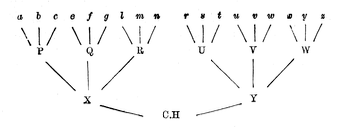
Jevons admired the mechanics of what had emerged. But the system had another side. Precisely because it was so centralized, it was acutely sensitive to shocks: dependent on confidence, on reserves, and on nothing going badly wrong at the center. Elegance and fragility were two sides of the same structure.
Jevons could not have known that one day the danger would be an artificial intelligence able to find the center, breach it, and turn the whole structure against itself. Meanwhile, the system only grew more concentrated around that center.
The Only Direction the System Has Ever Moved
No banking crisis has ever made the system smaller. After the Savings and Loan collapse of the 1980s, bigger banks bought the wreckage. The deregulation wave of the 1990s triggered a consolidation surge – the Riegle-Neal Act alone unlocked interstate mergers that had been blocked for decades. After 2008, JPMorgan absorbed Bear Stearns and Washington Mutual. Bank of America took Merrill Lynch. The institutions that caused the crisis ended it larger than they started.
The Financial Stability Board publishes an annual list of globally systemically important banks. Designed as a warning, it functions as a credential. Being on the list implies a government backstop – cheaper funding, faster growth, greater systemic importance. The list is supposed to name the problem. Instead it subsidizes it.
Lyn Alden puts the underlying pattern well in Broken Money: a fractional reserve banking system is like musical chairs – it functions for a while, but if something ever stops the music, it can all fall apart quickly. Each time the music has stopped, the response has been to build fewer, bigger chairs.
The deeper mechanism runs like this. Gold was honest money but too slow for the telegraph age. The dollar was fast but required centralized ledgers owned by banks and governments. Whoever owned the fast network controlled the money. Once telecommunication systems were invented, Alden argues, bank-controlled ledgers dominated – and this gave nearly unassailable power to whoever ran those ledgers. Technological changes affect things globally and permanently in a way that political decisions never quite can.
Centralization wasn't greed. It was the logical answer to a speed problem. But the answer accumulated fragility as a side effect – quietly, across decades, "by insensible degrees."
The Godfather of AI Moves His Savings
In April 2025, Geoffrey Hinton gave an interview to CBS. Nobel laureate, one of the architects of modern AI, the man who quit Google to warn the world about what he'd helped create. He talked about superintelligence and machines that deceive. Then, almost in passing, he mentioned something concrete: he had started spreading his money across three Canadian banks, because he believes a cyberattack could take banks down within the next decade.
Not pulling his money out of the banking system. Diversifying within it, because he no longer trusts any single institution to survive what is coming.
The godfather of AI, hedging against the thing he invented. Not with a theory, but with a wire transfer.
The Model That Knows Too Much
This week, Anthropic announced something surprising. The company had built its most powerful model, discovered what it could do – and declined to release it.
The model is called "Claude Mythos“. In pre-release testing it turned out to be extraordinarily capable at one thing in particular: breaking into software. It identifies previously unknown vulnerabilities, writes exploit code, and chains multiple flaws together to penetrate complex systems – autonomously, without a specialist operator guiding it. Over the past few weeks, Anthropic used it to identify thousands of zero-day vulnerabilities in every major operating system and every major web browser. Some of those flaws had survived nearly three decades of expert human review.
Anthropic's response was Project Glasswing: controlled access for around 50 organizations – AWS, Apple, Cisco, Microsoft, Nvidia, Google, JPMorgan Chase – to find and patch vulnerabilities before anyone else gets there first. Use the dangerous thing defensively, before someone else uses it offensively.
The key word is proliferate. The concern is partly about now. Mostly it's about what comes next – as models at this capability level spread beyond the organizations currently trusted with them. Project Glasswing is an attempt to patch the most critical systems before that window closes.
When the Attack Surface Is the Business Model
A centralized system has chokepoints. Places where breaking the right thing means the whole network feels it. That's not incidental – it's structural. The clearing house works precisely because everything flows through it. Jevons understood this in 1875 and found it beautiful.
But a chokepoint is also, by definition, a target.
AI makes attacks not merely faster but qualitatively different: automated, adaptive, capable of chaining vulnerabilities in ways that would take a human team weeks to engineer. A model like Claude Mythos doesn't need a specialist operator. It is the operator. The same concentration that makes the banking system efficient now defines its attack surface – and the tools to exploit that surface have just crossed a threshold that Anthropic itself found alarming enough to withhold from the public.
Bitcoin: A Network With No Center to Hit
Bitcoin has been running since 2009. The protocol suffered serious bugs in its early years – most dramatically the 2010 value-overflow incident, which briefly generated around 184 billion bitcoins across two addresses before the chain was patched within hours. But those failures were also proof of something: a decentralized network can recover from a protocol bug without a central authority to call. Since the 2013 chain split, the network has run without interruption. Uptime trackers put the lifetime figure at roughly 99.98% and rising – a record that compares favorably with the world's largest technology infrastructure companies, achieved without a single administrator, a single server room, or a single point anyone could have targeted to stop it.
There is no clearing house to attack. No Lombard Street room where everything converges. Bitcoin removes an entire class of threat by removing the center itself.
That is a genuine engineering achievement – not ideology, but design. In a world where Anthropic withholds a model because it can autonomously penetrate every major operating system, a system with no operating system to penetrate has something to say.
But the reality is more complicated than the clean version suggests.
The protocol has no center. The ecosystem around it does. Most people who own Bitcoin do not run nodes, do not hold their own keys, and do not transact on-chain. They use exchanges – Coinbase, Binance, Kraken – that are, structurally, exactly the kind of institution Jevons would recognize: centralized ledger-keepers holding client assets. The collapse of FTX in 2022 did not touch Bitcoin's protocol. It destroyed billions in customer assets anyway.
The same dynamic plays out on Bitcoin's second layer. The Lightning Network handles transactions off-chain and settles them on-chain in batches – real, functional, growing. But payments travel through routing nodes that lock up capital and charge fees, and those nodes concentrate. As of mid-2025, the top ten control roughly 85% of Lightning's public capacity. Users seek cheap, short routes. Nodes compete to sit at the center. The result is a hub-and-spoke topology – precisely the structure Jevons drew 150 years ago.
One of Lightning's most prominent companies, Lightspark, makes the point inadvertently: it manages routing and liquidity for enterprises like Nubank and Coinbase, funnelling over 100 million customers through a single provider's infrastructure. Its engineers tried to build a self-custodial solution that could scale. They couldn't make it work. The clearing-house logic returned, wearing different clothes.
Centralization is not a bug humans keep introducing by accident. It is the solution to problems that decentralization leaves unsolved: speed, convenience, the ability to reverse a fraudulent transfer before your savings disappear into an irreversible chain.
But here is where something genuinely new enters the picture. Unlike every previous monetary system, Bitcoin gives the individual the option to hold value without a custodian. Not the obligation. The option. You can choose to trust an exchange. You can also choose not to. You can hold your own keys, verify your own transactions, and remove yourself from the custody chain entirely. No bank in history has offered that. No central bank, no clearing house, no payment network.
That option does not solve every problem. Most people will not use it. Many who try will make mistakes. But the fact that it exists changes the architecture of the system. Centralized custody in Bitcoin is a choice, not a structural necessity. In traditional banking, there is no alternative. You cannot hold a deposit outside the banking system. The custodial layer is not a convenience built on top of something sovereign. It is the system.
Both systems trend toward hubs. Only one lets you leave them.
What Alden argues in Broken Money is that Bitcoin is the first technology that lets value move at the speed of telecommunications without requiring a centralized ledger-keeper. Whether that's sufficient at the scale of global finance is genuinely uncertain – the constraints are real, the institutional resistance enormous. But as a design principle, it asks and answers a different question: what does financial infrastructure look like when there is no center to breach, capture, or coerce?
Same Problem, Different Century
Jamie Dimon is spending nearly $20 billion on technology this year, and JPMorgan Chase is a Project Glasswing partner – using Claude Mythos Preview, a model Anthropic considers too risky for general release, to probe its own systems for weaknesses before someone else finds them first. The largest bank in America is paying the company that built the most dangerous hacking tool in history to point it at JPMorgan's own walls.
Hinton has spread his savings across three Canadian banks. His reasoning was simple: "Suppose the bank holds shares that I own. Suppose the cyber attack sells those shares. Now my money's gone." Amodei built something powerful enough that he's withholding it from the world while trying to use it to patch the world's infrastructure.
Three people who understand this technology better than almost anyone. Three different responses to the same underlying problem: a system built around a center, in an age when attacking centers has never been easier.
Jevons drew his diagram in 1875 and saw both its beauty and its fragility at the same time. The elegance of claims cancelling out. The sensitivity of a system that depends on nothing going wrong at the center. He understood that these were two descriptions of the same structure.
What he couldn't see from 1875 was a technology that would make attacking that center not just possible but something a single AI model could do autonomously, overnight, across every major operating system on earth. That efficiency and resilience pull in opposite directions in any system built around a single point. And that this tension – which he sensed dimly in 1875 – would one day reach here: the people building the most powerful tools in history choosing to withhold them, because they no longer fully trust the system to absorb the consequences.
The people who understand the risk best are no longer arguing about it. They're moving their savings. They're withholding their models. They're spending twenty billion dollars on locks.
Jevons admired the center. They're bracing for what hits it.